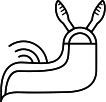
Mostly animals
Plus the occasional tree
And a few landscapes
Whispers from the Northern Lights
In some Sámi traditions, the northern lights are treated with deep respect, and whistling at them is considered dangerous. Some believe the lights can hear you and might swoop down if you attract their attention. The aurora isn't just something to watch—it is something to approach with humility.
Senja, Norway
Western Honey Bee
Apis mellifera
The western honey bee communicates through dance. The dancers' Hivemates sometimes butt their heads against the dancer and produce a little "stop signal" buzz to tell her the advertised location was a bad one when they disagree.
Finnfjordbotn, Norway
Stormoa
Stormoa is Senja's second highest mountain. There's often a small cloud hovering around its peak, which is a result of orographic lift: A cloud can form around a mountain peak when moist air is forced upward by the terrain. As the air rises, it cools and reaches its dew point, causing water vapor to condense into clouds. This can create a distinctive "cap" or "dome" of cloud around the summit, which may appear almost stationary even though air is continuously moving through it.
Senja, Norway
Northern Lights at Trælen
In some Sámi traditions, the Northern Lights were believed to be the souls of the dead. Because of this, people treated the aurora with great respect and were warned not to whistle, shout, or wave at it—otherwise it might notice them and come down to take them away.
Ersfjorden, Senja, Norway
Sheathed Woodtuft
Kuehneromyces mutabilis
Its species name mutabilis means "changeable" — and it's fitting in more ways than one. The caps look dramatically different depending on moisture: when wet they're smooth, greasy, and dark brown, but as they dry they fade from the center outward, creating that "two-toned" look that gives it names like "two-toned woodtuft."
Chanterelle
Cantharellus cibarius
Chanterelles don't really grow alone underground like many mushrooms — they form a mycorrhizal partnership with tree roots, trading minerals and water for sugars from the tree.
Bjorelvnes, Norway
Botnvatnet
The aurora is happening far above the clouds—typically around 100–300 km above Earth. So when you see the northern lights dancing over a mountain, they can actually be hundreds of kilometres above it.
Bergsbotn, Senja, Norway
Pearl-bordered Fritillary
Boloria euphrosyne
Butterflies in this family "taste" with their feet — females drum leaves with their forelegs to chemically confirm it's the right violet before laying an egg.
Grasmyra, Senja, Norway
Cloudberry
Rubus chamaemorus
Cloudberries are dioecious — meaning male and female flowers grow on separate plants. So a patch of cloudberries only produces fruit where both male and female plants grow nearby, which is one reason they can be maddeningly scarce even where the plants themselves seem plentiful.
Nordmarka, Oslo, Norway
Winter Is Near
This photo was taken in late autumn, when the trees were shrouded in frosted fog.
Gudbrandsdalen, Norway
Fallow Deer
Dama dama
Jægersborg Dyrehave is home to around 2,000 free-ranging deer, and the animals have been roaming the parkland for centuries.
Copenhagen, Denmark
Cane Toad
Rhinella marina
Cane Toads don't drink water. Instead, they absorb moisture directly through the skin of their belly—from wet ground, sand or dew.
Queensland, Australia
Satin Bowerbird
Ptilonorhynchus violaceus
Male satin bowerbirds build elaborate structures called bowers to attract females. They decorate them with blue objects (the bluer the better)—including feathers, berries, flowers, and even pieces of plastic.
Fraser Island, Australia
Cane Toad
Rhinella marina
Cane toads were introduced to Australia in 1935 to control sugar-cane pests, but instead they became a major invasive species. Today, they are found across large parts of northern Australia and pose a serious threat to native wildlife because of their powerful toxin.
Queensland, Australia
Eastern Water Dragon
Intellagama lesueurii
These dragons can hold their breath up to 90 minutes.
Queensland, Australia
Common Frog
Rana temporaria
Frogs form large choruses in a competition to attract females. Stamina is important: The loudest, and longest, calls win, probably because it indicates good genes.
Lillomarka, Oslo, Norway
Purple-Edged Ceratosoma
Ceratosoma tenue
Identification of sea slugs are often difficult. The keys to identification in this case is the broken purple rigde together with the placement of the three mantle lobes on both sides of the body. One lobe on either side of the head, one on the side of the gills, and one between those two.
Lembeh Strait, Indonesia
Old Norwegian Sheep
There are at least 19 types of sheep in Norway. They're bred for various qualities; softness of the wool, or color, tameness and taste of the meat. The Old Norwegian Sheep is also called wild sheep, and stone age sheep. It's one of the oldest sheep types we have, and forage outdoors all year. It's almost as hardcore as the Icelandic sheep.
Brønnøy, Norway
Striated Frogfish
Antennarius striatus
Frogfish can inhale their prey in six thousands of a second. That's one of the fastest eating methods known in the animal kingdom.
Lembeh Strait, Indonesia
Skeleton Shrimp
Caprellid sp.
The rear legs are used to hook itself to plants where it lives, in this case a bryozoan. Front claws are used for hunting and moving around.
Lembeh Strait, Indonesia
Balloonfish
Lophodiodon calori
The large dragon-like eyes help this nocturnal hunter forage for food during the night-hours. Their eye pattern is a mesmerizing sight. A friend once compared it to a reflection of the universe.
Lembeh Strait, Indonesia
Flamboyant Cuttlefish
Metasepia pfefferi
The flambouyant cuttlefish flashes its hypnotic color scheme and pulses its fins when approached, possibly to signal its toxicity to potential predators.
Lembeh Strait, Indonesia
Striped Poison-Fang Blenny Mimic
Petroscirtes breviceps
The strait of Lembeh is littered with garbage, but not all discarded stuff is bad for the creatures living there. An old bottle can be the safest place for a blenny to live.
Lembeh Strait, Indonesia
Broadclub Cuttlefish
Sepia latimanus
Cuttlefish are able to change the color of their skin in an instant using a set of astonishing ten million individually controlled color cells.
Dampier Strait, Raja Ampat, Indonesia
Bluestripe and Golden-Lined Snappers
Lutjanus kasmira and Lutjanus lutjanus
The goatfish (Mulloidichthys mimicus) is part of a weird relationship with the bluestripe snapper where it mimics its colors to look almost exactly the same. The reason for that is not entirely clear, but the goatfish is presumably a more preferred prey than the bluestrip snapper. So there may be some goatfish in the fish ball as well.
Dampier Strait, Raja Ampat, Indonesia
Bigeye Trevally
Caranx sexfasciatus
This fast-swimming predator can grow up to 120 cm long and form schools numbering more than 1500 individuals.
Dampier Strait, Raja Ampat, Indonesia
Bobbit Worm
Eunice aphroditois
Little is known about the behaviour of bobbit worms. It's theorized that the worm doesn’t see at all but uses its excellent receptors to detect movement in the water to sense nearby fish.
Lembeh Strait, Indonesia
Balloonfish
Lophodiodon calori
The balloonfish can inflate its body three times the normal size to make attacks more difficult for predators.
Lembeh Strait, Indonesia
Clown Anemonefish
Amphiprion percula
When anemonefish leaves it host for a long time, they need to re-adapt to the host stinging cells. To do so, the fish goes through a dance-like ritual taking several hours. Clownfish rarely move more than 30 cm from their host anemone, though.
Dampier Strait, Raja Ampat, Indonesia
Ornate Ghost Pipefish
Solenostomus paradoxus
The ghost pipefish camouflages very well in coral reefs, and spend a lot of time floating, almost like a slow moving leaf, with its mouth pointed downwards.
Lembeh Strait, Indonesia
Reef Manta Ray
Manta alfredi
By swimming against the tidal current, mantas sieves zooplankton from the water. They are the only type of ray evolved to filter feed.
Baa Atoll, The Maldives
Scalloped Hammerhead Shark
Sphyrna lewini
All of our dives on Cocos featured hammerheads, most shy and in the distance like here. One of my best memories from Cocos was the ascent on a site called Manuelita, which we dove many times. What we didn't realize at first was that the hammerheads had disperged and moved away when we got there. Immediately when we started to ascend they returned. During our safety stop we saw the hoards coming from all directions and reuniting at the cleaning stations on the ocean floor.
Cocos Island, Costa Rica
Indian Lionfish
Pterois miles
Active at night, this fish will follow you and exploit your dive light to find prey.
Shaab El Erg, Egypt
SS Thistlegorm
Sunk during a surprise attack by a pair of German Heinkel He-111 bomber planes in World War II. The ship is over 400 feet long, and most of its cargo is still present in, or around the wreck.
Egypt
Pyjama Nudibranch
Chromodoris quadricolor
Sponges are popular food source for nudibranchs. The slugs incorporate the color from what they eat to their tissue color as camouflage. This beautiful pair have found a toxic finger-sponge (Negombata magnifica) to feed on. They won't be harmed, and instead use the chemicals to reduce the chance of being eaten.
El Minya Wreck, Egypt
Lumpsucker
Cyclopterus lumpus
Instead of having the normal type of pelvic fins (below), this fish has evolved disc-like fins and use them to adhere to the substrate.
Gulen, Norway
Elphinstone Anthias
Anthiinae (family)
Participating in a huge feeding aggregation, the massive amount of anthias make some of the visually dramatic scenes on the reef. Anthias live in harems consisting of one dominant male, a few lesser males, juveniles and a cluster of females. All anthias are hermaphrodites and begin life as female.
Elphinestone Reef, Egypt
False Clown Anemonefish
Amphiprion ocellaris
Clownfish hatch near the surface and travel deeper to search for a host anemone when they reach their juvenile stage. Within a clownfish community there is a strict hierarchy where juveniles begin at the bottom and have to gradually move upwards by proving their abilities to the rest of the population. During this time they may be victims to agression, and possibly eviction from the anemone by more mature clownfish.
Dumaguete, The Philippines
Norton 16H Motorcycles
More than 100 motorcycles were aboard the SS Thistlegorm before it sunk. Many of them are still there.
SS Thistlegorm Wreck, Egypt
The Dugongs of Marsha Shouna
Dugong dugon
Dugongs are believed to be inspirations behind tales of mermaids and in parts of Indonesia they are considered reincarnations of women. The word "dugong" means lady of the sea. It's herbivorous and feed uniquely on sea grass. Their numbers are very low and in some countries they are entirely depleted due to hunting, bycatch and habitat destruction. I was extremely lucky to encounter one in Marsha Shouna on the western coast of the Red Sea, once home to thousands of dugongs but now with very few individuals. The 100 km coastline along Marsa Alam had only seven dugongs left at the time of writing.
Marsa Alam, Egypt
Fuchsia Flatworm
Pseudoceros ferrugineus
Flatworms lack circulatory and respiratory organs (such as gills), and respiration is performed by diffusion through the worm's entire surface. They are somewhat similar to nudibranchs in appearance, but the similarity is only superficial. It's easy to distinguish them by the lack of antennas/rhinophores, that they generally move faster. And they are also flat.
Dumaguete, The Philippines
Nudibranch
Hypselodoris infucata
Many nudibranchs use their brightly colored bodies to warn potential predators that they are full of distasteful chemicals. This is an alternative defence mechanism to having a hard shell, which most other molluscs use as primary protection.
Anilao, The Philippines
Magnificent Sea Anemone
Heteractis magnifica with Amphiprion perideraion
The previous name for this anemone was the Ritteri Anemone, updated to Heteractis magnifica, or "Magnificent Sea Anemone". Perhaps so because it's too beautiful for the first dull name. The anemone can entirely retract it's tentacles. It's column, here in purple color, will then be exposed. On the matter of reproducing this anemone can do it both sexually and asexually—it can actually clone itself.
Anilao, The Philippines
Reticulate Stargazer
Uranoscopus chinensis
Night dives at the Anilao pier feel like something from another world. The sandy bottom comes to life with all the crabs, shrimps, worms, slugs and bottom dwellers doing their brutal routine. Many of these animals feed at night, and the site turns to a large scale battlefield when the sun sets. A stargazer approached us in the midst of the chaos, landed on the sand and burrowed its tapered body, exposing only its big, heavy, flat head and a vertically slanted mouth. He waits for passing fish before jumping upwards while creating a vacuum to suck in the prey.
Anilao, The Philippines
Tiger Shark
Galeocerdo cuvier
The tigers have excellent sense of smell and sight. Some native Hawaiians think their eyeballs have the power to look into the future.
Cocos Island, Costa Rica
Juvenile Boxfish
Ostracion cubicus
The members of the boxfish family display a unique behavior of blowing into the sand of the sea floor to uncover buried food, such as tasty worms and shrimps. The boxfish is one of those animals being consistently cute its entire lifetime, not just as juvenile.
Anilao, The Philippines
St. John's Cave Systems
St. Johns is know for its array of caverns, tunnels, overhangs and swim-throughs. The sun pierce through the cracks, crevices and holes inside the caverns, guiding us through the maze. The majestetic area is like a forgotten world, mountains now covered in coral.
St. Johns Reef, Egypt
Toad Crab
Hyas coarctatus
This decorator crab collects sea weed, sponges, algae and other particles in the water to improve its camouflage.
Gulen, Norway
Spinner Dolphin
Stenella longirostris
Those times I'm lucky enough to hear whistles and clicking sounds I instantly change focus from finding small stuff, snails or whatever I'm up to at the moment, and instead scout for what could be dolphins. They are fast swimmers, so if they are around, they are not necessarily for long. Most often I will not find them, but sometimes I do, and some of these encounters I believe are the dolphins approaching me more than the other way around. They are curious, playful and intelligent creatures.
Egypt
Reef Stonefish
Synanceia verrucosa
Motionless, this fish sometimes stay at the same site for several months. Not agressive, but will inject a venom if stepped on. It's the world's most venomous fish.
The Barge Wreck, Egypt
Devil Scorpionfish
Scorpaenopsis diabolus
Normally, pectoral fins are used to swim but this fish has evolved two small stilts that allow it to walk and dig the seabed instead. While this is by no means unique for an ocean species, it's still fascinating to observe this type of irregularity. Perhaps, a long time ago another species did just the same, and that is why there are creatures (such as you and me) walking on land today.
Anilao, The Philippines
The Hilma Hooker Wreck
After losing power off the coast of Bonaire, The Hilma Hooker was towed to the island's main pier. As this ship already was suspected by the DEA, a search was quickly conducted and 11.000 kg of marijuana was found. The owner of the ship however, was not. Hilma Hooker was starting to wear down and the hull was in dire need of maintenance. It was towed a couple of kilometers south in fear of disrupting boat traffic in case it sunk, which it promtly did. Now it's a great dive site, easily accessible on the western coast of Bonaire.
Bonaire, The Netherlands
Spinner Dolphin
Stenella longirostris
Dolphins use echolocation to "see" the environment, similar to a sonar or radar. They send out bursts of clicking sounds, and based on the frequency of the return signal, and how much time the signal used to return, the dolphin can estimate what kind of objects are nearby.
Egypt
Spotted Scorpionfish
Scorpaena plumieri
The scorpionfish is commonly found virtually invisible, blending in with the environment. Do not touch.
Bonaire, The Netherlands
Chamberlain's Nembrotha
Nembrotha chamberlaini
Perhaps the most distinctive characteristic of nudibranchs is the pair of tentacles on the head, called rhinophores. They are chemical sensors used to smell and taste the chemicals dissolved in the water, such as food and potential mates. Many species of nudibranchs can retract these vital organs to protect them against other fish.
Anilao, The Philippines
Spotted Moray Eel
Gymnothorax moringa
Unlike most fish who use suction to capture their prey, moray eels use two sets of jaws in their throats to drag prey inside their mouths.
Bonaire, The Netherlands
Bobbit Worm
Eunice aphroditois
The bobbit is my favorite worm. It can grow up to a meter, has a stunning purple iridescence, five antennae to sense passing fish and a scissor-like mouth to split prey in half. Most of the body is covered in sand, just enough is exposed to ambush surprised fish. This worm is quite rare, shy, and mysterious.
Anilao, The Philippines
Thresher Shark
Alopias macrourus
Malapascua is known for its legendary thresher sharks. They are usually found in deep waters, but when the sun starts to rise they ascend to the cleaning stations on the sloaps of Monad Shoal. Diving starts 05.00 am.
Malapascua, The Philippines
Arminid Nudibranch
Janolus sp.
Nudibranchs have shells as larva, but shed them when they mature. Shells are heavy and make moving around difficult. Most molluscs use the shell as a primary defence, but nudibranchs have developed other techniques for protection, such as toxic secretion. A few make their own poisons, but most utilize the toxic metabolites from what they eat.
Anilao, The Philippines
Coleman's Shrimp
Periclimenes colemani
The pair of shrimp clears a little patch on the fire urchin with their claws. The patch is just large enough to move freely around collecting small pieces of food while still being protected from predators by the urchin's toxic spines. The largest of the shrimps is always the female.
Anilao, The Philippines
Painted Frogfish
Antennarius pictus
The social activity of this fish is rather limited, and the male will sometimes eat the female if she stays around too long after mating.
Anilao, The Philippines
Red Sea Corals
Water temperatures in the Red Sea peaks at 35 degrees celcius. Most reefs bleach and die off in such conditions while the Red Sea corals linger on. They are remarkably resilient to high temperatures. Scientists are trying to figure out the key to this crucial ability, with hope of some day be able to salvage reefs currently suffering from rising sea temperatures in other parts of the world.
Egypt
False Clown Anemonefish
Amphiprion ocellaris
Sea anemones are poisonous to most fish. The clownfish however is immune to their stinging tentacles and form a symbiotic relationship with the anemone where the clownfish receive protection from predators, and the anemone benefits from the clownfish' natural activity. For example, the wedging swimming movements from the clownfish stimulate water sirculation around its tentacles, increasing metabolism and growth.
Dumaguete, The Philippines
Graeffe's Sea Cucumber
Pearsonothuria graeffei
The sea cucumbers are scavengers, crawling mostly around the sea floor. Not always though: since their gametes float around in the water column a vertical positioning is thought to increase the chance of successful reproduction for both male and female.
Anilao, The Philippines
Green Turtle
Chelonia mydas
It's believed that green turtles need between 20–50 years to reach sexual maturity, and a turtle's life is not easy so very few reach adulthood. Once, the estimate was one percent. It dropped to one thousandth. Previously suffering from unrestricted exploitation by humans, turtles are now having more like a global protection status. However, their slow reproductive rate, combined with increased development in coastal areas make the species very vulnerable. Many turtles are also lost due to accidental catch by fishermen.
Marsa Alam, Egypt
Green Turtle
Chelonia mydas
The green turtles inhabit coastal areas of as many as 140 countries. The Caribbean Islands have one of the largest populations of green turtles in the world.
Bonaire, The Netherlands
Titan Triggerfish
Balistoides viridescens
Scattered throughout the world's seas, the triggerfish is usually a solitary fish. It's territorial and can be nasty to intruders if there are eggs to protect. Be respectful and watch its signals, an erect dorsal spine (on top of the fish) means stay away.
Egypt
Dwarf Minke Whale
Undescribed (Balaenoptera acutorostrata subspecies)
In Australia, a group of whales circled us and gradually came closer for each round they took. As they moved closer we could recognize their fine details, their uniqueness and beauty. Scientists in Australia use the spots on their skin to distinguish them from each other and is the primary method used to count the number of individuals. We dove with all together five minke whales for almost two hours before they perished into the open sea. It was a once-in-a-lifetime experience I will never forget.
Ribbon Reefs, Great Barrier Reef, Australia
Giant Frogfish
Antennarius commerson
In just two weeks, the frogfish can change its own color to match the environment. They generally do not move very much, but sometimes use the pelvic fins (the ones below the body) to walk along the sea floor. Their pectoral fins (one on each side) are used for stability.
Anilao, The Philippines
Silky Shark
Carcharhinus falciformis
Once abundant in the world's oceans, now overfished and in some places depleted. The silky is the shark second most commonly taken as bycatch due to commercial fishing of tuna, it's favored prey.
Elphinestone Reef, Egypt
White-Spotted Hermit Crab
Dardanus megistos
A hermit crab's home is the shell of a gastropod, usually snails. As they grow, larger shells are required. However, suitable intact shells are of limited resource and competition for the best shell among hermit crabs is common. If a crab looking for new vacancy finds a shell that is too large, it will stay in its current shell and wait by the vacant shell for other hermit crabs to arrive. As other crabs arrive and check the shell, they will do the same and when finally one finds the vacant shell suitable, each crab exchange shells in sequence.
Anilao, The Philippines
Banded Coral Shrimp
Stenopus hispidus
Prefers to live in caves, often seen upside down. Cleans parasites from fish cruising by.
Bonaire, The Netherlands
Bluecheek Butterflyfish
Chaetodon semilarvatus
Endemic to the Red Sea and Gulf of Aden, the bluecheek butterflyfish is one of the few species of fish that have long-term mates.
Egypt
White-Eyed Moray
Gymnothorax thyrsoideus
Moray eels are shy creatures usually seen peeking out from rocks and coral formations with only their heads exposed. Most of the long slender body is hidden inside crevices, where it retreats completely if you approach too fast or come too near.
Dumaguete, The Philippines
Round Ribbontail Ray
Taeniura meyeni
This type of ray is overfished across much of it's range. However, they thrive around Cocos and we saw them on almost all dives.
Cocos Island, Costa Rica
Juvenile Blacktip Reef Shark
Carcharhinus melanopterus
Patrolling the shallows, half a dozen or so juvenile blacktips are using the safe nursing grounds outside a small beach on the island Perhentian Besar to practice the skill of hunting.
Perhentian Besar, Malaysia
Potato Cod
Epinephelus tukula
A large, friendly and curious fellow. The potato cods are rare but territorial, thus quite easy to find once located. They seem to chill out at the same place, getting cleaned by wrasses. One of the potato cods on the barrier reef was so large it was nicknamed VW Beetle.
Cod Hole, Great Barrier Reef, Australia
Klara of Pandan Island
On a tiny island just outside Mindoro in the Philippines lives an old parrot named Klara, watched over by the two owners of the island. Over time I learned there was more to the story than just keeping a parrot as a pet. In fact, it's very touching but too long to write here. Ask me one time if you want to hear it.
Pandan Island, The Philippines
Wire Coral Shrimp
Pontonides unciger
Lives exclusively on the black coral whip, usually in pairs. I found only one, but they are very well camouflaged and small, so perhaps a second companion was around somewhere. You may wonder why the whip is called black coral when it's bright green, and the reason is due to its black inner skeleton. The outer flesh varies in color and P. Unciger shrimps adapt by changing their own skin to match the coral's color.
Anilao, The Philippines